
Have you ever wondered whether your hamster can actually see your face, recognize you across the room, or tell you apart from other family members? Hamsters have very different eyesight from humans, and their world is shaped by more than what they see. They rely heavily on their sense of smell, hearing, and familiarity with their surroundings. Understanding how they recognize people can help you build trust and handle your hamster more confidently.
Quick Answer: How Do Hamsters See Humans?
Hamsters can see humans, but their eyesight is relatively poor compared with ours. They do not see fine facial details as clearly as people do, and their vision is not their strongest sense.
Instead, hamsters rely heavily on:
- Smell: Helps them identify familiar scents, including those associated with their owners.
- Hearing: Helps them notice familiar voices and sounds.
- Vision: Helps them detect movement, light, shapes, and nearby objects.
- Touch: Helps them explore their surroundings and recognize familiar physical contact.
Your hamster may become familiar with your scent, voice, daily routine, and handling style. However, this does not mean it recognizes your face in the same detailed way another person would.

What Do Hamsters Actually See When They Look at Humans?
Imagine standing several feet away from your hamster and calling its name. It may turn toward you, but that doesn’t necessarily mean it can clearly see your facial features.
Hamsters have eyes adapted to their natural lifestyle, and their visual abilities differ considerably from human vision.
1. Hamsters Have Relatively Poor Eyesight
Hamsters are generally considered to have poor visual acuity. They do not see fine details as clearly as humans.
This means your hamster may struggle to distinguish small facial features, recognize detailed expressions, or identify objects from a distance.

A human face that looks perfectly clear to you may appear much less detailed to your hamster.
However, poor eyesight does not mean complete blindness. Hamsters can use vision to detect their surroundings and respond to visual changes.
2. They Can Notice Movement
Movement is an important visual cue.
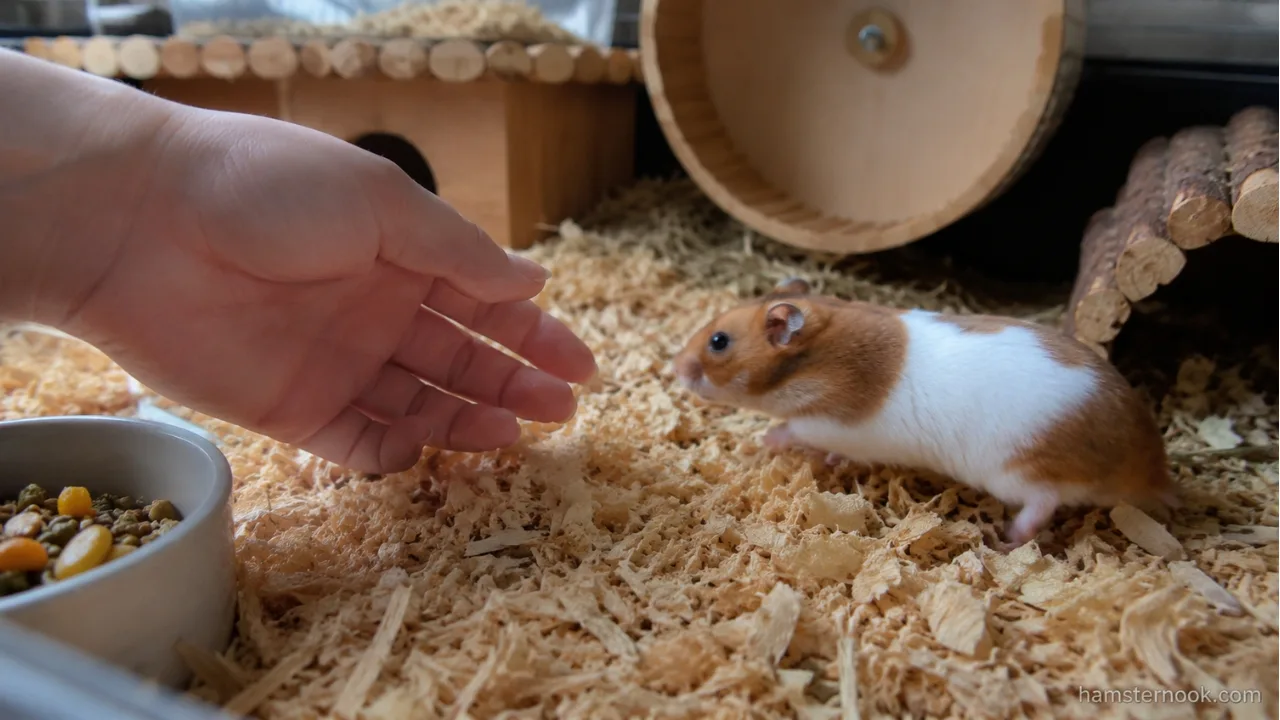
Your hamster may notice your hand approaching its enclosure even if it cannot clearly identify your fingers or face.

This also explains why sudden movements can startle a hamster. An approaching object may be detected visually before your pet has enough time to investigate it using smell or touch.
Try approaching your hamster slowly rather than reaching into its enclosure unexpectedly.
3. They Do Not See Human Faces as Clearly as We Do
Humans rely heavily on facial recognition. We notice eyes, expressions, and small differences in facial appearance.
Hamsters are not known to depend on this type of detailed visual recognition.

Your hamster may become familiar with you without being able to identify your face in the same way another human would.
Its familiarity with you is more likely to involve several senses working together.
Can Hamsters Recognize Their Owners?
Yes, hamsters can become familiar with people who regularly care for them. However, recognizing a familiar owner should not be confused with human-style facial recognition.
A hamster’s response may be influenced by repeated exposure to familiar scents, sounds, handling, and daily routines.

For example, your hamster might approach the enclosure when you arrive, investigate your hand, or remain calmer when you handle it gently.
These behaviors can indicate familiarity, although no single behavior proves that your hamster recognizes you.
For more practical signs that your hamster feels comfortable and trusts you, see 10 Signs Your Hamster Trusts You: How to Tell If They Like You.
1. Your Scent Helps Your Hamster Become Familiar With You
Smell is particularly important in a hamster’s world.

Hamsters have a well-developed sense of smell and use scent-related information to investigate their environment and other animals.
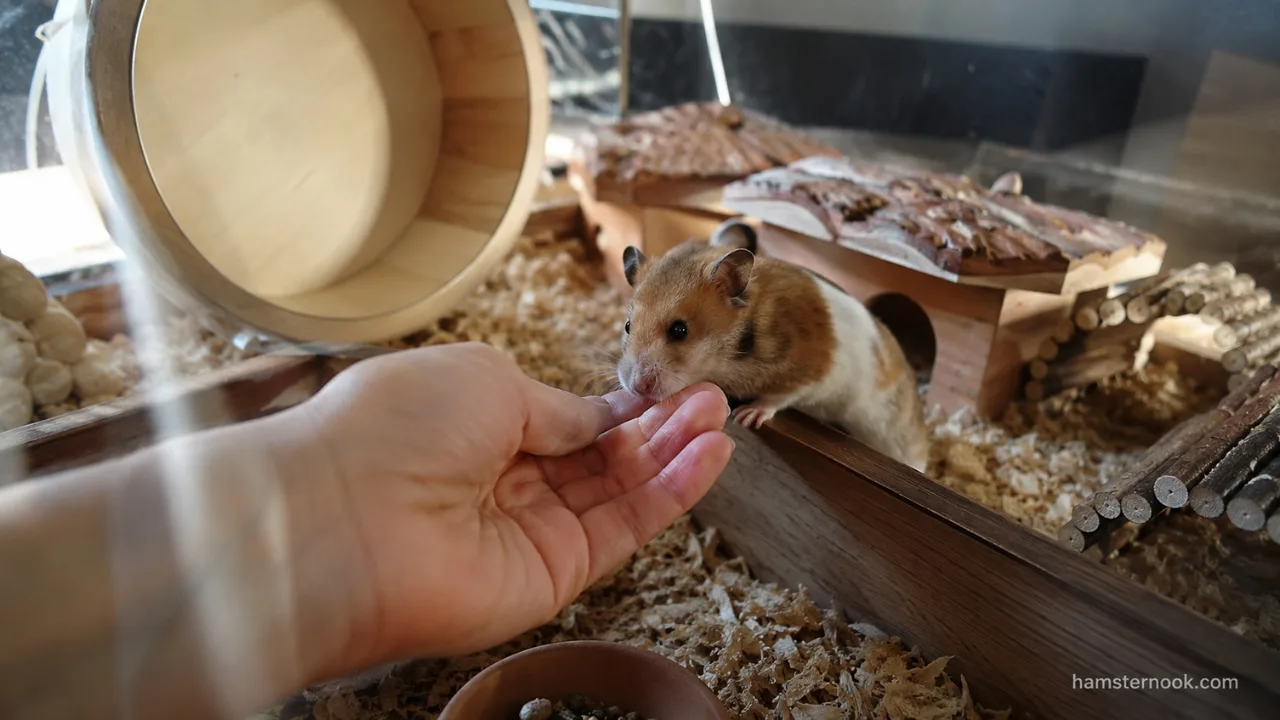
Your hands carry a familiar scent from repeated interactions. Over time, your hamster may become accustomed to that scent.
For a more focused explanation of how familiar human scents may help hamsters identify their regular caregivers, see Can Hamsters Recognize Their Owners by Smell? Signs to Look For.
This is one reason it is helpful to let your hamster investigate your hand before attempting to pick it up.
Avoid using strongly scented hand creams, perfumes, or soaps immediately before handling your pet.
2. Your Voice Can Become Familiar
Hamsters have a well-developed sense of hearing.
They can detect sounds that people may not notice, including higher-frequency sounds. They also respond to sounds in their environment.
For a closer look at the sounds hamsters can detect and how their hearing works, see Do Hamster Have Sensitive Hearing? What Their Ears Can Detect.

Your hamster may become accustomed to hearing your voice during feeding and handling routines.
Speaking gently before approaching the enclosure can help your pet become familiar with your presence.
However, this does not establish that hamsters understand human words or recognize individual voices in the same way people do.
3. Your Daily Routine Makes You Predictable
Imagine that you feed your hamster around the same time each evening.

After repeated experiences, your hamster may become familiar with the routine and the sounds associated with feeding.
It may start exploring when it hears you approaching or notices the usual activity around its enclosure.
This response can reflect learned associations rather than proof of human-style recognition.
Can Hamsters Recognize Your Face?
This is one of the most common questions new hamster owners have. You might notice your hamster reacting differently when you approach compared with when a stranger comes near.

But does that mean your hamster recognizes your face?
There is no strong evidence that pet hamsters identify individual human faces the way people do. Their relatively poor eyesight makes detailed facial recognition an unlikely primary way of identifying their owners.
Instead, they can learn to associate familiar people with recognizable experiences.
For example:

- Your scent may become familiar through repeated handling.
- Your voice may become associated with feeding time.
- Your hand may become associated with gentle interaction.
- Your usual approach may signal that food or attention is coming.
These associations can help your hamster become more comfortable around you.
Can a hamster recognize its owner from a distance?
Your hamster may notice you approaching its enclosure, particularly if you move or make familiar sounds.
However, it is difficult to establish whether the animal identifies you visually from a distance or responds to other familiar cues.
A hamster approaching the enclosure when you arrive is not necessarily recognizing your face. It may be responding to your footsteps, voice, scent, or a familiar routine.

What Colors Can Hamsters See?
Many hamster owners wonder whether their pets see the world in black and white.
The answer is more complicated than that.
Hamsters have visual systems adapted to their natural activity patterns, and research has identified rod-dominated retinas in golden hamsters. Rod cells are particularly useful for detecting light under dim conditions.
For more information about how hamsters use their vision in low-light conditions, see Can Hamsters See in the Dark? What They See at Night.

The RSPCA also notes that hamsters are capable of ultraviolet vision, although the significance of this ability in hamsters is not fully understood.
This means we should avoid assuming that hamster vision works exactly like human vision.
Do hamsters see red, blue, and green?
Human color perception and hamster color perception are not identical.
There is not enough reliable, directly applicable evidence to provide a simple color chart showing exactly how every pet hamster sees red, blue, green, and other colors.

It is also misleading to claim confidently that hamsters see everything in black and white.
For everyday hamster care, color is less important than making the enclosure safe, providing familiar objects, and avoiding sudden changes that might startle your pet.
Why Does My Hamster Sometimes Stare at Me?
Have you ever noticed your hamster sitting still and looking in your direction?
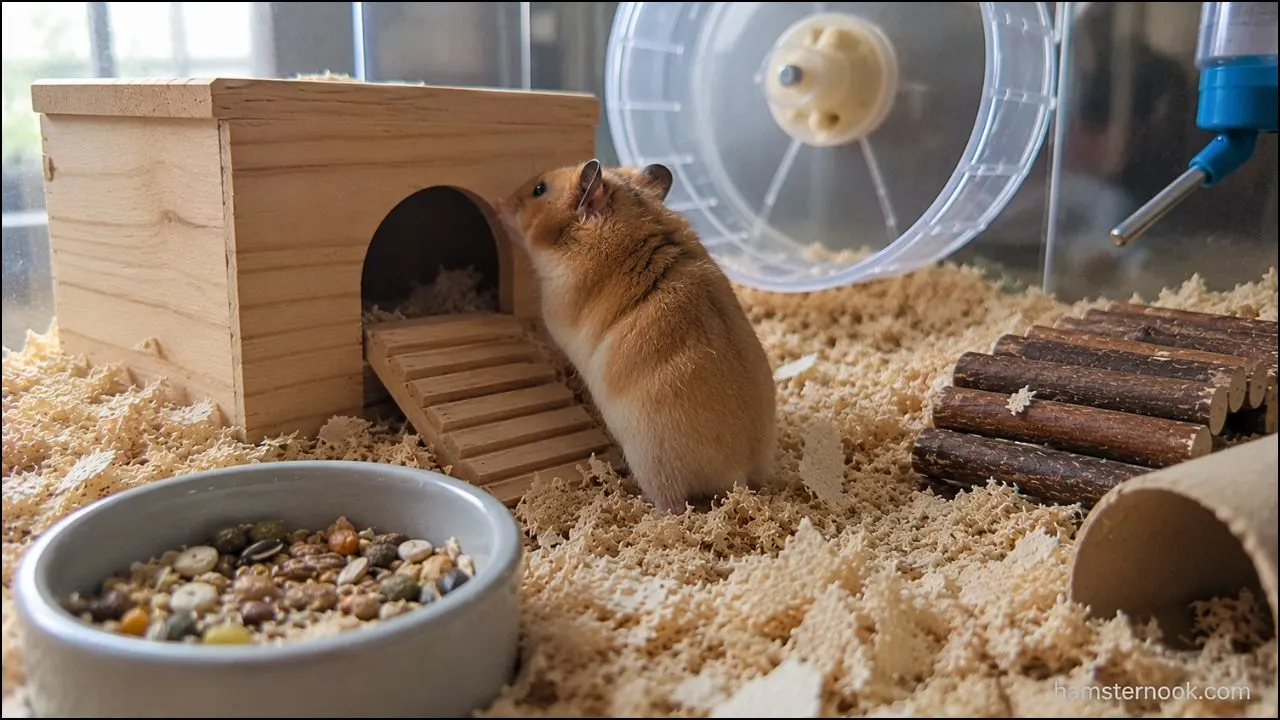
It may seem as though your pet is studying your face, but there are several possible explanations.
1. Your hamster has noticed movement
Hamsters can detect moving objects despite their relatively poor eyesight.
If you move your hand, walk past the enclosure, or approach the food bowl, your hamster may pause and pay attention.
2. It is investigating a familiar sound
Your hamster may hear your footsteps, voice, or movements around the enclosure.
It might stop what it is doing to investigate where the sound is coming from.

3. It is assessing an unfamiliar situation
Hamsters are prey animals and can be cautious around unfamiliar sights, sounds, and smells.
A hamster that suddenly stops moving when someone approaches may simply be assessing the situation.
Do not assume that every instance of staring means fear or affection. Look at the hamster’s overall behavior and whether it returns to normal activity.
Why Does My Hamster Get Scared When I Put My Hand Near It?
This behavior often surprises beginners.
You may feed your hamster every day, speak gently, and spend time near its enclosure, yet it still runs away when you reach toward it.
Poor eyesight can help explain why sudden movements are unsettling.
Your hamster may not clearly see your hand approaching until it is relatively close. At the same time, an unfamiliar smell or unexpected movement may make the situation feel threatening.
Common reasons your hamster may run away
- You approached too quickly.
- Your hand appeared suddenly from above.
- Your hamster was sleeping.
- Your hands smelled unfamiliar.
- Your hamster has not become comfortable with handling.
- The enclosure was disturbed unexpectedly.
Remember that hamsters are small prey animals. Being cautious around a much larger animal is a natural protective response.
For more possible reasons a hamster avoids an approaching person and how to respond, see Why Does My Hamster Run Away From Me? 7 Reasons & What to Do.
How to approach your hamster without frightening it
Try this simple routine:
- Approach the enclosure calmly.
- Speak softly before reaching inside.
- Allow your hamster to notice your presence.
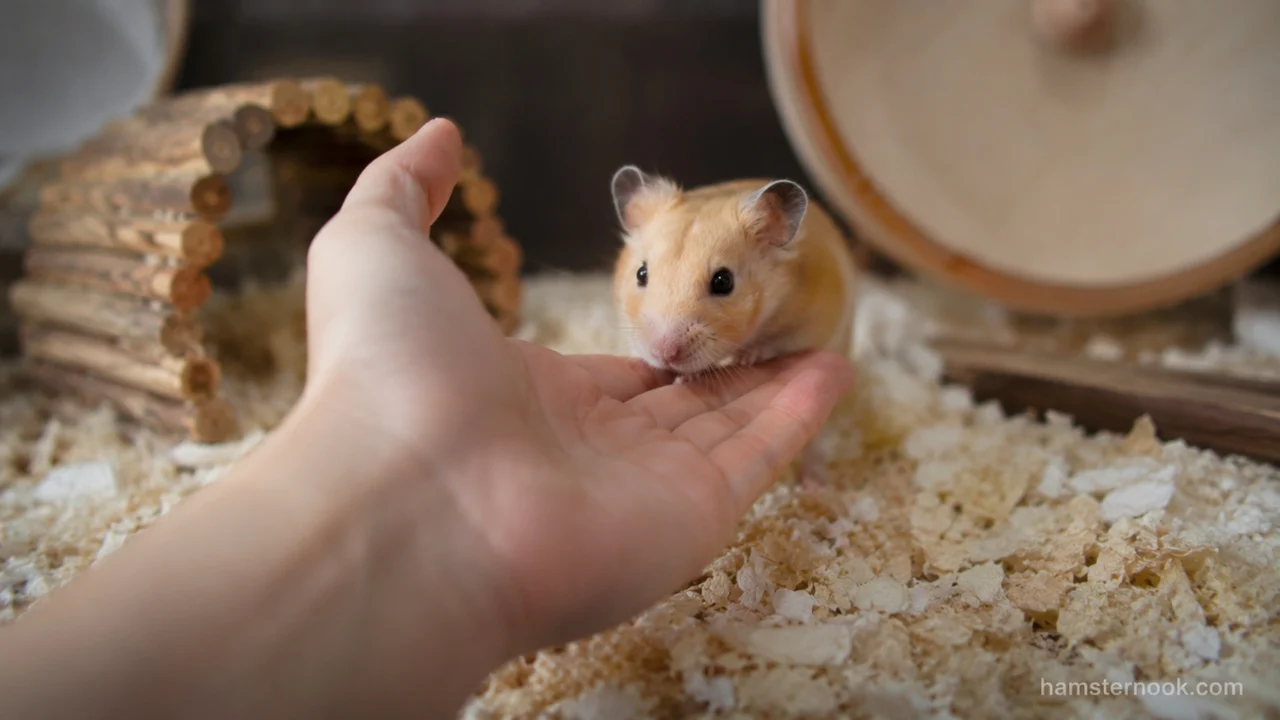
- Place your hand near the hamster without chasing it.
- Let it investigate your fingers at its own pace.
- Avoid picking it up if it is clearly frightened.
Give your hamster time to become comfortable. Trust develops through repeated, gentle interactions rather than forcing physical contact.
For a step-by-step approach to helping a hamster become comfortable with handling, see How to Tame a Hamster: 10 Gentle Steps to Build Trust.

How Do Hamsters Use Their Other Senses to Recognize You?
Vision is only one part of how hamsters understand their surroundings.
Their other senses provide important information about nearby people, food, objects, and potential threats.
Sense of smell
Smell is particularly important for hamsters.
They use scent information in their environment, including for social communication. Repeated exposure to your natural scent may help your hamster become familiar with you.

For this reason, avoid handling your hamster immediately after applying strongly scented products.
You should also wash your hands before handling it, especially after preparing food or touching another animal. This helps remove unfamiliar or potentially harmful substances.
Sense of hearing
Hamsters have well-developed hearing and can detect sounds that humans cannot hear.
Your voice, footsteps, and regular household sounds may become familiar through repeated exposure.
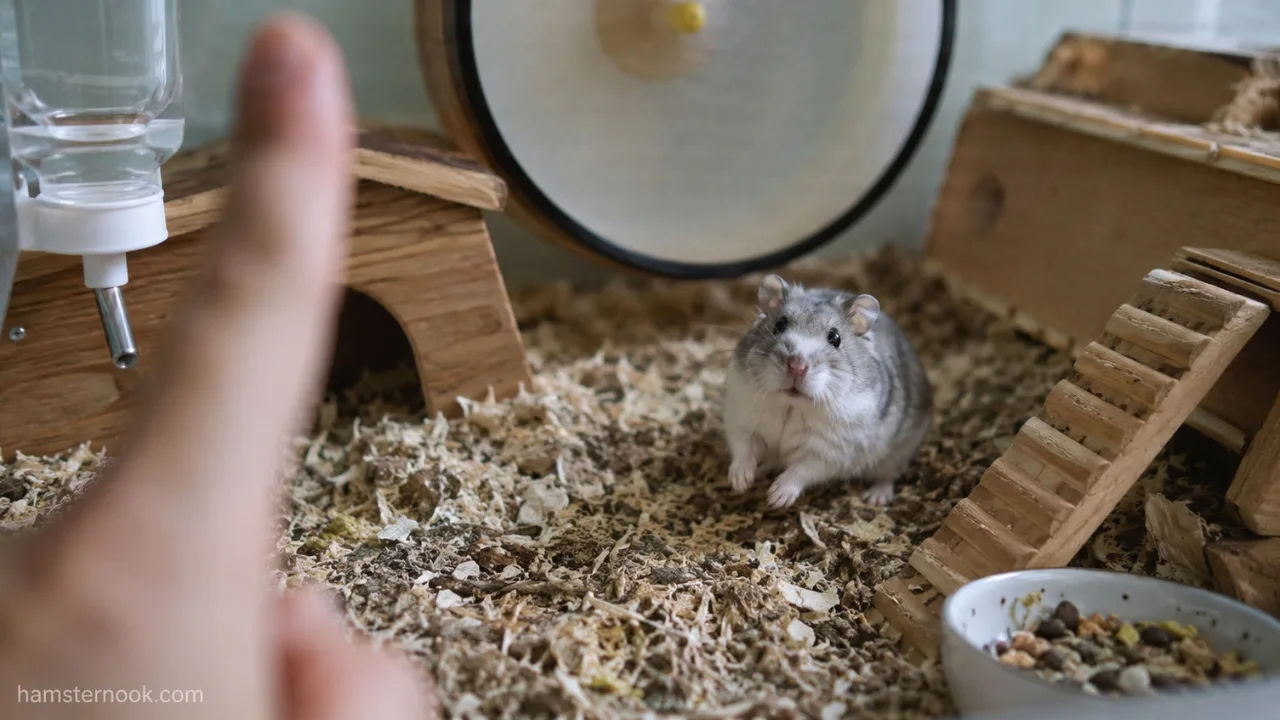
Speaking gently before approaching the enclosure is a useful habit because it gives your hamster an opportunity to notice you before you make physical contact.
Avoid shouting, banging on the enclosure, or deliberately making loud noises to get its attention.
Sense of touch
Hamsters also use touch when exploring nearby objects.
Their whiskers help them gather information about their immediate surroundings, particularly when navigating close to objects.

This is another reason to avoid rearranging the entire enclosure unnecessarily. Familiar surroundings can help your hamster navigate and explore more comfortably.
Do Hamsters Recognize Their Owners by Smell?
They can become familiar with a person’s scent, but it is better not to assume that every hamster uses smell in exactly the same way.
Hamsters have scent glands and use scent for communication and marking. Familiar smells are part of the information they encounter in their environment.
Your hamster may become accustomed to your natural scent through repeated feeding and handling.

This is why consistency can help when building a relationship with a new hamster.
Try to:
- Handle your hamster with clean, unscented hands.
- Avoid switching between strongly scented hand products.
- Let your hamster sniff your fingers before touching it.
- Avoid forcing interaction when it moves away.
- Keep handling sessions calm and predictable.
Your hamster does not need to recognize your face to become comfortable with you.
How to Build Trust With Your Hamster
If you want your hamster to become comfortable around you, focus on creating positive and predictable experiences.

Step 1: Give your hamster time to settle in
A newly adopted hamster needs time to become familiar with its enclosure and surroundings.
Avoid immediately trying to pick it up or repeatedly disturbing its sleeping area.
Let it explore its new home and establish a comfortable routine.
Step 2: Spend time near the enclosure
Sit near the enclosure during your hamster’s usual active period.

Speak gently so it can become familiar with your voice.
You don’t need to touch your hamster during every interaction. Simply allowing it to observe and investigate your presence can be useful.
Step 3: Offer a treat from your hand
Once your hamster appears comfortable, offer a small suitable treat using your open hand.
Allow it to approach voluntarily.

If it takes the treat and walks away, let it do so. Avoid following it around the enclosure.
Step 4: Allow voluntary contact
When your hamster regularly approaches your hand, allow it to investigate your fingers.
Gradually introduce gentle handling if it remains comfortable.
Use cupped hands and handle your hamster close to a safe surface to reduce the risk of injury if it jumps.

Step 5: Keep interactions consistent
Short, calm interactions are generally more useful than forcing your hamster to remain in your hands.
Pay attention to its response. If it repeatedly runs away, struggles, or tries to bite, give it space and try again another time.
Signs Your Hamster Is Becoming Comfortable With You
Every hamster has an individual temperament. Some become comfortable with handling relatively quickly, while others prefer to interact without being picked up.
You may notice:

| Behavior | What it may indicate |
|---|---|
| Approaches your hand | Willingness to investigate |
| Sniffs your fingers | Gathering scent information |
| Takes food from your hand | Increasing comfort with interaction |
| Explores while you are nearby | Greater familiarity with your presence |
| Remains relaxed during gentle handling | Tolerance of physical contact |
| Responds to familiar feeding sounds | Learned association with a routine |
None of these behaviors independently proves affection or human-style recognition.
A hamster can become comfortable with your presence without enjoying being held.
That is perfectly fine. Respecting its individual preferences is part of good hamster care.
Common Mistakes Owners Make When Interacting With Hamsters
Understanding hamster vision can help you avoid several common handling mistakes.
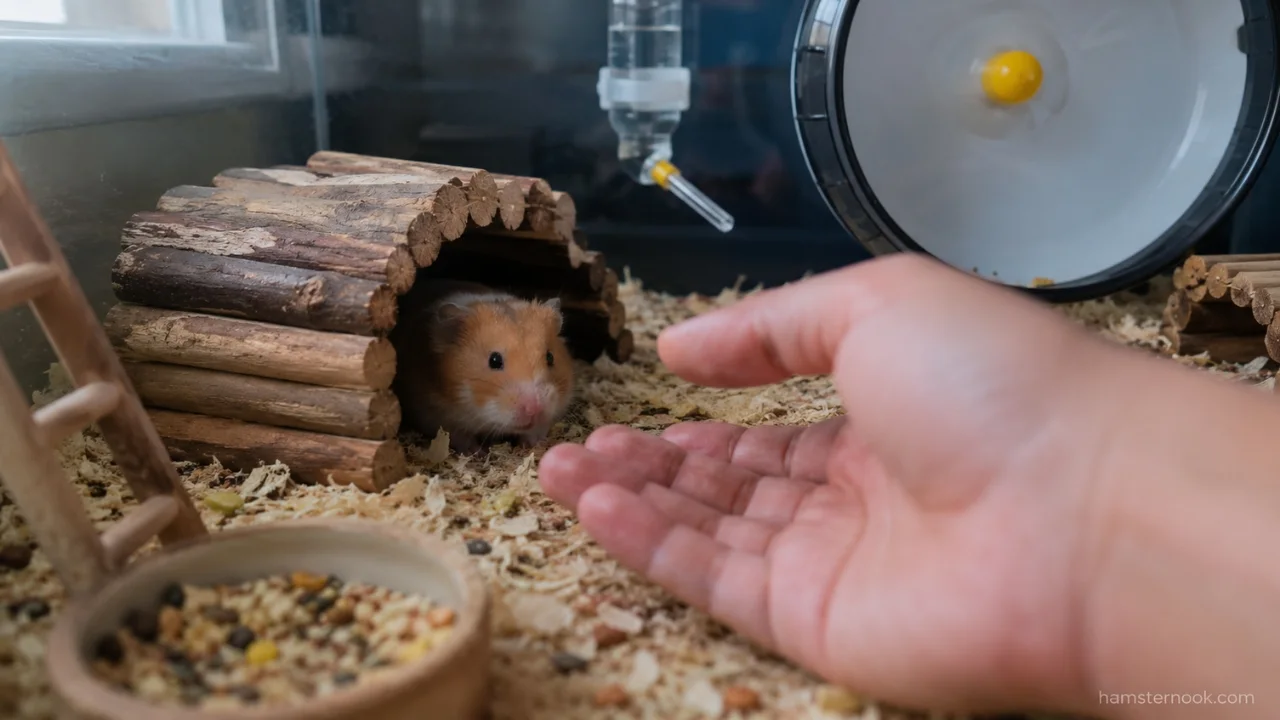
1. Approaching suddenly from above
A large hand suddenly appearing above a small animal can be frightening.
Approach calmly and allow your hamster to notice your presence first.
2. Assuming your hamster can see your fingers clearly
Your hamster may not identify your approaching fingers as clearly as you expect.
Speak softly and move slowly before making contact.

3. Waking your hamster to play
Hamsters need uninterrupted opportunities to rest.
Avoid waking your pet simply because you want to interact with it. Wait until it naturally becomes active.
4. Expecting every hamster to enjoy being held
Some hamsters become comfortable climbing onto their owners, while others prefer exploring hands without being lifted.
Do not force physical contact to achieve a particular level of tameness.

5. Using treats to force interaction
Treats can help create positive associations, but they should not be used to lure a frightened hamster into an uncomfortable situation.
Allow your hamster to approach and leave freely.
Can Poor Eyesight Cause Problems for Pet Hamsters?
Hamsters naturally have relatively poor eyesight, but an existing vision problem should not automatically be dismissed as normal.
A hamster that occasionally misjudges an object or gets startled by an approaching hand is not necessarily experiencing an eye disorder.

However, a noticeable change in the appearance of the eyes or a sudden change in navigation deserves attention.
For information about eye abnormalities, discharge, swelling, and when veterinary attention is needed, see Hamster Eye Problems: Sticky Eyes, Discharge, Infections & When to See a Vet.
Watch for:
- Cloudiness in one or both eyes.
- Swelling around the eyes.
- Eye discharge.
- An eye that appears unusually enlarged or protruding.
- Persistent difficulty navigating familiar surroundings.
- Sudden changes in normal activity.
These signs can have different causes and should not be diagnosed at home.

When should you contact a veterinarian?
Contact a veterinarian experienced with small mammals if you notice persistent eye discharge, swelling, cloudiness, or a sudden change in your hamster’s ability to navigate.
An eye that becomes severely swollen, injured, or protruding needs urgent veterinary assessment.
Do not apply human eye drops or attempt to clean an injured eye with household products.
What You Should Do to Help Your Hamster Recognize and Trust You
You cannot teach your hamster to recognize your face in the same way a person recognizes another person. However, you can help it become familiar with your presence.

Follow these practical habits:
- Approach the enclosure slowly.
- Speak gently before reaching inside.
- Keep your handling routine consistent.
- Allow your hamster to investigate your natural scent.
- Offer occasional suitable treats from your hand.
- Avoid waking your hamster unnecessarily.
- Never chase it around the enclosure.
- Respect its preference for or against being handled.
- Keep its surroundings reasonably familiar.
- Observe its behavior rather than assuming what it is feeling.
Over time, your hamster may become more comfortable approaching you and interacting with your hands.
Final Thoughts
Hamsters do see humans, but they don’t see the world in the same detailed way we do. Their eyesight is relatively poor, and they depend heavily on smell, hearing, and touch to understand their surroundings.
Your hamster may not recognize your face clearly, but it can become familiar with your scent, voice, handling routine, and the experiences associated with your presence.

If your hamster approaches your hand, takes food from you, or remains relaxed when you are nearby, these can be signs of growing familiarity.
Don’t measure your relationship by how often your hamster wants to be held. Give it time, respect its boundaries, and let trust develop naturally.
Frequently Asked Questions
1. Can hamsters see humans?
Yes. Hamsters are not naturally blind. However, their eyesight is relatively poor compared with human vision. They can detect movement and objects but do not see fine details as clearly as people.
2. Do hamsters recognize their owners?
Hamsters can become familiar with their regular caregivers through repeated experiences involving scent, sounds, handling, and daily routines. However, there is limited evidence about how pet hamsters distinguish individual human owners.

3. Can my hamster recognize my face?
There is no strong evidence that hamsters recognize human faces in the same detailed way people do. Their relatively poor visual acuity means scent, hearing, and familiar interactions are likely more useful cues.
4. Can hamsters recognize their owners by smell?
Hamsters have a well-developed sense of smell and use scent information for communication. They can become familiar with scents associated with regular interactions, although individual recognition should not be assumed from scent alone.
5. Do hamsters recognize their owner’s voice?
Hamsters have well-developed hearing and can become accustomed to repeated sounds. Your voice may become a familiar part of their environment, but this does not necessarily mean they recognize individual voices in the human sense.
6. Do hamsters see in the dark?
Hamsters have rod-dominated retinas that help them function under dim lighting. However, they are not capable of seeing in complete darkness without any light.

7. Do hamsters see in color?
Hamster color vision differs from human color vision. Research has identified ultraviolet sensitivity in hamsters, but their complete color-perception abilities are not sufficiently understood to provide a reliable human-style color chart.
8. Why does my hamster run away when it sees me?
Your hamster may be startled by movement, unfamiliar smells, sudden sounds, or an approaching hand. It may also simply prefer to remain in its hiding place. Approach slowly and allow it to investigate you voluntarily.
9. Why does my hamster stare at me without moving?
It may have noticed your movement or heard something nearby. Hamsters sometimes pause to investigate unfamiliar situations. A brief pause is not necessarily a sign of fear or affection.
10. Can hamsters see their food clearly?
Hamsters can detect objects and movement, but they also use smell and touch when investigating nearby food. Their eyesight is not their only way of locating and identifying food.

11. Can hamsters see their owners from across the room?
They can detect visual changes and movement at a distance, but it is difficult to know whether a hamster identifies a particular person visually from across a room. Familiar sounds and other cues may contribute to its response.
12. Are hamsters scared of human hands?
Not necessarily. A hamster that has not become accustomed to handling may find an approaching hand frightening. Slow movements, familiar scents, and voluntary interaction can help build comfort.
13. Do hamsters love their owners?
We cannot establish human-style love from hamster behavior. However, hamsters can become comfortable with familiar caregivers and develop positive associations with repeated gentle interactions.
References
This guide is based on veterinary and animal welfare resources covering hamster sensory abilities, eyesight, hearing, smell, behavior, handling, and responses to their surroundings, including:
- RSPCA – Keeping Hamsters as Pets – Information on hamster sensory abilities, smell, hearing, touch, visual adaptations, learning, and responses to unfamiliar sights, sounds, and smells.
- NC3Rs – Housing and Husbandry: Hamster – Guidance on hamster eyesight, detecting movement, careful approaches, handling, and reducing stress during interaction.
- Veterinary Partner – Husbandry and Medical Care of Hamsters – Veterinary information about hamster eyesight, hearing, smell, and safe handling.
- Royal Veterinary College – Caring for Your Hamster – Veterinary guidance on hamster behavior, handling, and general care.
- PetMD – How to Care for Your Hamster – Veterinary-reviewed information on hamster handling, socialization, poor eyesight, and recognizing potential health concerns.
Medical Disclaimer: This article provides general information about hamster senses and behavior. It does not replace professional veterinary advice. If your hamster develops eye abnormalities, sudden vision changes, or other concerning symptoms, consult a qualified veterinarian.

Narayan Kumar is the founder and author of HamsterNook. He creates practical, research-based hamster care guides covering hamster behavior, nutrition, cage setup, enrichment, health, and everyday care. His goal is to help hamster owners make informed decisions and provide safer, healthier lives for their pets through clear, beginner-friendly information based on trusted animal care resources.