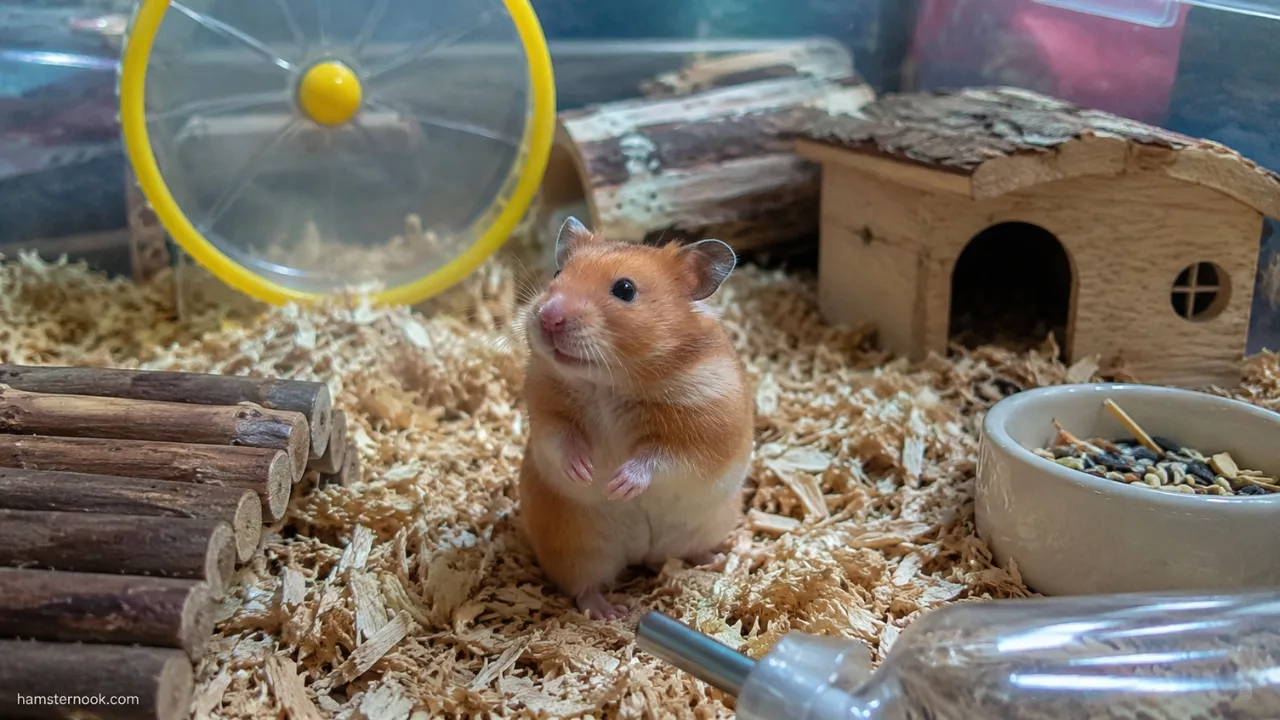
Understanding your hamster’s behavior is one of the most important parts of responsible ownership. Unlike dogs or cats, hamsters don’t communicate through obvious facial expressions or vocal sounds. Instead, they rely on body language, scent, movement, daily routines, and instinctive behaviors to respond to the world around them. To an experienced owner, these small actions tell a surprisingly detailed story about how a hamster is feeling.
For beginners, however, those same behaviors can be confusing. One day your hamster spends hours digging tunnels, the next day it hides all evening, suddenly freezes when you walk by, or starts rearranging the entire cage overnight. It’s easy to wonder whether these behaviors are normal or signs that something is wrong.
The reality is that most hamster behaviors have a clear purpose rooted in their natural instincts. Understanding those instincts helps you make better decisions about housing, handling, feeding, enrichment, and health care. More importantly, it allows you to recognize when a behavior is simply part of being a hamster—and when it deserves closer attention.
This complete guide brings together everything every hamster owner should know about hamster behavior. Throughout the guide, you’ll learn what different behaviors mean, why they happen, which ones are completely normal, which ones may signal stress or illness, and how to respond in a way that keeps your hamster healthy and comfortable.
Quick Answer
Hamsters communicate primarily through body language, scent, movement, routines, and instinctive behaviors. Actions such as burrowing, hoarding food, running on a wheel, grooming, and sleeping during the day are all normal behaviors for healthy hamsters. Instead of focusing on one unusual action, owners should watch for sudden changes in their hamster’s normal routine, as consistent behavioral changes often provide the earliest clues that something in the environment—or the hamster’s health—has changed.
If you’re completely new to hamster ownership, Ultimate Hamster Care Guide for Beginners (2026) explains the essential daily care routine that makes understanding hamster behavior much easier.
One important thing to remember is that no single behavior tells the whole story. Healthy hamsters often repeat the same routines night after night, and those routines naturally change with age, environment, temperature, and confidence. Instead of judging one unusual action, experienced owners watch for consistent patterns over several days. This approach helps distinguish harmless instincts from genuine health or welfare concerns far more accurately than reacting to isolated behaviors.
Why Hamster Behavior Is Often Misunderstood
One of the biggest challenges for new owners is expecting hamsters to behave like larger companion animals.
Dogs and cats often communicate in ways people immediately recognize, but hamsters rely on much quieter signals. Because they are prey animals, their body language is usually subtle, making careful observation much more important.
Hamsters evolved very differently.
In the wild, they survive by avoiding predators rather than attracting attention. Remaining quiet, hiding, freezing, storing food, and staying underground are survival strategies that have developed over thousands of years.
Although pet hamsters have been bred in captivity for generations, these natural instincts remain remarkably strong.
Because of this, behaviors that may seem strange to humans are often completely normal for a hamster.
For example:
- Sleeping most of the day.
- Digging long tunnels.
- Hiding food.
- Ignoring people after waking.
- Rearranging bedding every night.
- Running for long periods on an exercise wheel.
These are not signs of a stubborn or unhappy hamster. They are normal behaviors that allow hamsters to express instincts they would use in the wild.
Understanding this difference changes the way you interpret almost everything your hamster does.
Every Behavior Has a Purpose
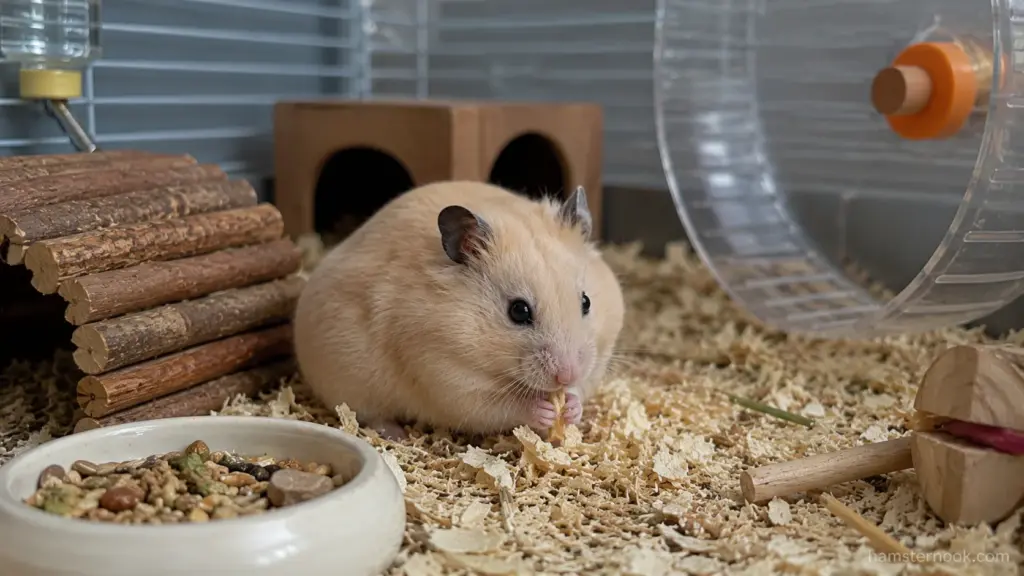
Hamsters rarely perform random actions.
Almost every repeated behavior serves a purpose related to one of five basic needs:
- Staying safe.
- Finding food.
- Conserving energy.
- Exploring the environment.
- Protecting territory.
When owners recognize which need a particular behavior is fulfilling, the behavior usually becomes much easier to understand.
For example:
A hamster digging constantly is usually trying to build a secure underground space.
A hamster storing food is preparing for future meals.
A hamster freezing after hearing a sudden noise is checking for possible danger.
A hamster grooming after eating is simply maintaining its coat.
Looking at behavior through this perspective helps avoid unnecessary worry and prevents owners from accidentally interrupting healthy natural activities.
How Hamsters Communicate Without Words

Hamsters don’t need spoken communication to express how they feel.
Instead, they combine several forms of communication that work together.
Learning to recognize each one gives you a much clearer picture of your hamster’s emotional state.
Most communication happens without sound. A hamster constantly combines scent, posture, whisker movement, ear position, and daily routines to gather information about its surroundings. Learning to observe these small signals together gives a much more reliable picture than focusing on only one behavior.
Body Language
Body posture is often the easiest behavior to observe.
A hamster’s overall posture can indicate whether it feels:
- Relaxed
- Curious
- Alert
- Nervous
- Defensive
- Comfortable
Unlike facial expressions, body posture usually changes immediately as the hamster reacts to its surroundings.
Later in this guide, you’ll learn how to recognize common body language signals and what they usually mean.
Scent
Smell is one of the most important senses a hamster possesses.
Hamsters constantly use scent to understand their surroundings.
They leave scent markers that help them:
- Recognize familiar places.
- Locate food stores.
- Navigate tunnels.
- Identify safe sleeping areas.
This is one reason why removing every piece of bedding during cage cleaning can temporarily increase stress.
Without familiar scent markers, the enclosure suddenly feels completely unfamiliar.
If you’re unsure how often bedding should actually be replaced, How Often Should You Change Hamster Bedding? A Complete Cleaning Schedule explains how to clean the enclosure while preserving your hamster’s sense of security.
Hearing
Hamsters have excellent hearing.
They can detect sounds well beyond the range of normal human hearing.
Because of this, they often react to noises owners don’t even notice.
Examples include:
- Vibrations from household appliances.
- Plastic bags moving.
- Electronic devices.
- Other pets walking nearby.
- High-pitched sounds.
A hamster that suddenly freezes may simply be responding to a sound you cannot hear.
Touch
Touch also plays an important role.
Hamsters explore their surroundings using their whiskers, nose, paws, and body.
Their whiskers constantly measure:
- Tunnel width.
- Nearby objects.
- Air movement.
- Distance.
This allows them to navigate confidently even in very low light.
Natural Instincts Still Control Modern Pet Hamsters
Many owners assume pet hamsters gradually lose their wild instincts.
In reality, most natural behaviors remain almost unchanged.
Even though domestic hamsters receive regular food, safe housing, and protection from predators, they continue performing behaviors that helped their wild ancestors survive.
Understanding these instincts makes everyday behavior much easier to interpret.
Even after many generations in captivity, domesticated hamsters still rely on instincts that originally helped wild hamsters survive. Their homes may be safer today, but behaviors such as digging, hiding, food storage, nest building, and exploring remain deeply rooted and should be encouraged rather than discouraged.
Burrowing
Burrowing is one of the strongest natural instincts in every hamster species.
Wild hamsters spend much of their lives underground.
Their tunnels provide protection from predators, extreme temperatures, and changing weather conditions.
Pet hamsters continue expressing this instinct whenever deep bedding is available.
A hamster spending several hours digging tunnels is usually demonstrating healthy, natural behavior rather than boredom.
Providing enough bedding allows this instinct to develop safely.
If you’re planning a better enclosure, How Deep Should Hamster Bedding Be? explains why proper bedding depth is essential for natural digging and burrowing behaviors.
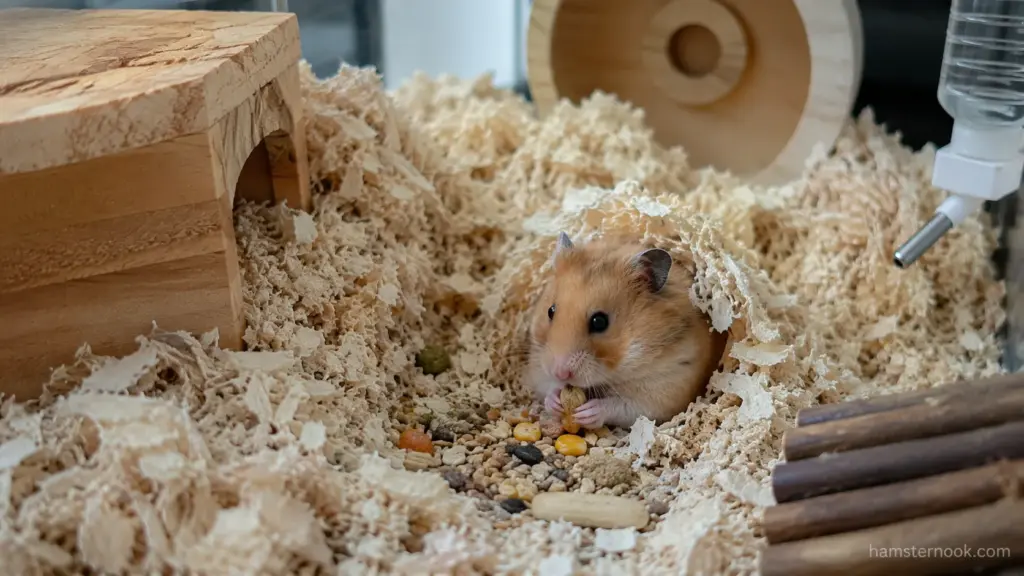
Food Hoarding
Food hoarding often surprises first-time owners.
Many people worry after finding piles of food hidden beneath bedding or inside sleeping chambers.
This behavior is completely normal.
Wild hamsters never know when food will become scarce.
Collecting and storing food increases their chances of survival.
Domestic hamsters continue following this instinct even though fresh food is provided every day.
Rather than removing every hidden seed, owners should usually remove only spoiled fresh foods while leaving clean, dry food stores untouched.
For a deeper explanation, Why Does My Hamster Keep Hiding Food? explores why food hoarding remains one of the strongest natural instincts in pet hamsters.
Exploration
Hamsters are naturally curious animals.
Whenever something changes inside the enclosure, they usually investigate.
Examples include:
- New toys.
- Fresh bedding.
- Different hideouts.
- New tunnels.
- Rearranged accessories.
Exploring helps hamsters build a mental map of their surroundings and identify anything unfamiliar.
This curiosity plays an important role in keeping them mentally stimulated.
Normal Behavior vs. Behavioral Changes
One of the most valuable skills a hamster owner can develop is learning the difference between normal behaviors and changes in normal behavior.
Healthy hamsters may:
- Sleep most of the day.
- Hide food.
- Dig constantly.
- Rearrange bedding.
- Run long distances on their wheel.
- Groom several times every night.
These actions alone are rarely cause for concern.
Instead, pay attention to sudden changes.
For example:
| Usually Normal | May Need Closer Observation |
|---|---|
| Burrowing every evening | Suddenly stopping all burrowing |
| Running nightly | Completely abandoning the wheel without explanation |
| Eating normally | Refusing favorite foods |
| Sleeping during daylight | Sleeping unusually longer while also becoming inactive at night |
| Hiding after cage cleaning | Hiding continuously for several days alongside appetite changes |
Looking at patterns instead of isolated behaviors provides a much more accurate understanding of your hamster’s wellbeing.
Every Hamster Has a Different Personality
No two hamsters behave exactly alike.
Even hamsters of the same species raised under similar conditions can develop very different personalities.
Some naturally become:
Some hamsters naturally become curious, confident, outgoing, and highly food-motivated, while others stay cautious, quiet, and slow to trust. Both personalities are completely normal.
Others remain:
- Quiet.
- Cautious.
- Easily startled.
- Slow to trust people.
Neither personality type is better than the other.
Understanding your hamster’s individual routine is one of the best ways to notice genuine behavioral changes later.
If you’re currently working on taming, The Complete Guide to Building Trust With Your Hamster offers practical tips for developing a stronger bond over time.
Understanding Everyday Hamster Behaviors
Most healthy hamsters follow a predictable routine every day. While individual personalities vary, many behaviors are shared across nearly all hamster species because they are driven by instinct rather than training.
Learning these behaviors helps owners distinguish between normal habits and signs that something may need closer attention.
Daily routines vary from hamster to hamster. Some spend more time exploring, while others prefer digging or rearranging bedding. As long as your hamster continues eating, drinking, grooming, and remaining active during its normal waking hours, differences in routine are usually part of its individual personality rather than a sign that something is wrong.
Burrowing
Burrowing is one of the strongest natural behaviors a hamster can display.
Wild hamsters spend much of their lives underground in complex tunnel systems. These burrows provide protection from predators, stable temperatures, and safe places to sleep and store food.
Pet hamsters retain exactly the same instinct.
When given deep bedding, a hamster may spend hours:
- Digging tunnels.
- Building sleeping chambers.
- Closing tunnel entrances.
- Moving bedding from one location to another.
- Expanding existing burrows.
Owners sometimes mistake constant digging for boredom or frustration. In reality, it usually indicates that the hamster is expressing one of its healthiest natural behaviors.
A hamster that never burrows may simply not have enough bedding depth.
If your hamster rarely burrows, How Deep Should Hamster Bedding Be? explains the bedding depth that allows natural tunnel building and nesting.
Food Hoarding
Food hoarding often surprises first-time hamster owners.
You clean the cage only to discover piles of seeds hidden beneath the bedding, inside tunnels, or under the sleeping nest.
This isn’t greed.
It’s survival.
Wild hamsters gather food whenever it’s available because future meals are never guaranteed.
Even though pet hamsters receive food every day, their instinct to store extra food remains extremely strong.
Healthy food hoarding usually includes:
- Carrying food inside cheek pouches.
- Creating underground food stores.
- Moving food between hiding places.
- Separating dry food from nesting material.
Fresh foods that spoil should be removed during routine cleaning.
Dry seed mixes or pellets stored in clean areas usually don’t need to be disturbed.
For a more detailed explanation, Why Does My Hamster Keep Hiding Food? explores why this instinct remains so powerful even in domestic hamsters.
Wheel Running
One of the most recognizable hamster behaviors is running on an exercise wheel.
Many owners assume the wheel simply provides exercise.
While it certainly helps maintain physical fitness, wheel running also satisfies an important instinct.
Wild hamsters naturally travel considerable distances while searching for food, exploring territory, and locating safe nesting areas.
An exercise wheel provides a safe outlet for this natural drive.
A healthy hamster may:
- Run several times throughout the night.
- Alternate between running and exploring.
- Use the wheel more during active seasons.
- Stop occasionally to groom or eat before running again.
Some hamsters run for surprisingly long periods.
This is generally considered normal provided the hamster is otherwise healthy and continues eating, drinking, and behaving normally.
If your hamster suddenly becomes much more active than usual during the night, Why Is My Hamster Suddenly So Hyper at Night? explains why this often reflects natural activity patterns rather than a problem.
Sleeping During the Day
Perhaps the most misunderstood hamster behavior is sleeping.
New owners often worry because they rarely see their hamster awake during daytime hours.
In reality, this matches the hamster’s natural biological rhythm.
Hamsters are generally most active around dusk, dawn, and throughout much of the night.
During the day they usually remain inside:
- Burrows.
- Nest boxes.
- Hideouts.
- Deep bedding.
Repeatedly waking a sleeping hamster can increase stress and reduce trust over time.
Instead, plan handling and interaction during your hamster’s normal active hours whenever possible.
Grooming
Healthy hamsters are naturally clean animals.
They spend a significant portion of their waking hours grooming.
Typical grooming behaviors include:
- Washing the face with both front paws.
- Cleaning behind the ears.
- Licking and smoothing the fur.
- Cleaning the feet after digging.
- Grooming after eating.
Regular grooming helps:
- Keep the coat clean.
- Remove loose fur.
- Distribute natural skin oils.
- Maintain healthy skin.
Occasional grooming is completely normal.
However, excessive scratching, constant grooming, bald patches, or irritated skin should be investigated further because these changes may indicate parasites, allergies, or another health concern.
Chewing
Hamsters chew for a very important reason.
Unlike human teeth, hamster incisors grow continuously throughout life.
Chewing naturally wears the teeth down and helps prevent overgrowth.
Healthy chewing usually involves:
- Wooden chew toys.
- Safe branches.
- Cardboard.
- Hamster-safe enrichment items.
Chewing cage bars repeatedly, however, often suggests the enclosure needs improvement.
Possible reasons include:
- Insufficient space.
- Lack of enrichment.
- Stress.
- Frustration.
Instead of simply stopping the behavior, identify what may be causing it.
Standing Upright
Many owners notice their hamster suddenly standing on its back legs.
This behavior usually lasts only a few seconds.
Standing upright allows a hamster to:
- Smell the air.
- Listen carefully.
- Investigate movement.
- Look around unfamiliar objects.
This posture often indicates curiosity rather than fear.
If the hamster quickly resumes exploring afterward, the behavior is usually perfectly normal.
Freezing
Freezing is another instinctive survival behavior.
When a hamster suddenly becomes completely still, it is often assessing its surroundings.
This commonly happens after:
- A loud noise.
- An unfamiliar smell.
- Unexpected movement.
- Vibrations.
Remaining motionless makes prey animals less noticeable to predators.
Short periods of freezing followed by normal activity rarely indicate a problem.
If freezing becomes prolonged or occurs together with weakness, poor coordination, or breathing difficulties, closer observation is recommended.
Rearranging the Cage
Many owners spend time organizing their hamster’s enclosure only to discover that everything has been moved by morning.
This behavior is entirely normal.
Hamsters frequently:
- Move bedding.
- Build new tunnels.
- Relocate nesting material.
- Change sleeping chambers.
- Block tunnel entrances.
- Rearrange food stores.
Rather than trying to keep the enclosure exactly as you designed it, allow your hamster to organize its environment naturally.
If you’ve noticed this happening regularly, Why Does My Hamster Keep Rearranging Its Cage? explains why this behavior usually indicates a healthy, active hamster.
Hiding
Hamsters naturally spend much of their lives hidden.
Remaining concealed protects them from predators in the wild, and this instinct continues even in domestic environments.
A healthy hamster may hide:
- During daylight hours.
- After eating.
- During cage cleaning.
- After being startled.
- While sleeping.
Hiding alone should not automatically be considered a sign of illness.
Instead, look for accompanying changes such as loss of appetite, reduced activity during normal waking hours, or noticeable weight loss.
Exploring New Objects
Curiosity is another important natural behavior.
Whenever something changes inside the enclosure, many hamsters immediately investigate.
They may explore:
- New hideouts.
- Fresh bedding.
- Different toys.
- New tunnels.
- Rearranged accessories.
Exploration allows the hamster to build a mental map of its surroundings and determine whether anything poses a threat.
A hamster that confidently investigates new objects is often demonstrating normal curiosity rather than nervousness.
If you’re looking for safe enrichment ideas, 10 Ways to Make a Hamster Cage More Enriching and Less Boring provides practical activities that encourage healthy exploration without causing unnecessary stress.
Understanding Positive Hamster Behaviors
Many owners spend a lot of time worrying about behaviors that seem unusual, but they rarely ask an equally important question:
“What does a happy, comfortable hamster actually look like?”
Unlike some pets, hamsters don’t show happiness through obvious excitement or affection. Instead, they express comfort by following natural daily routines with confidence.
A hamster that feels secure usually spends its active hours exploring, digging, grooming, eating, and interacting with its environment instead of remaining fearful or constantly hiding.
Learning to recognize these positive behaviors can help you understand whether your hamster feels comfortable in its home.
Exploring the Cage With Confidence
One of the clearest signs of a comfortable hamster is confident exploration.
Healthy hamsters naturally investigate almost everything inside their enclosure.
You may notice your hamster:
- Walking through every tunnel.
- Climbing onto platforms.
- Smelling new objects.
- Checking food storage areas.
- Exploring hideouts.
- Running between different parts of the enclosure.
This isn’t random movement.
Hamsters regularly inspect their territory to make sure everything remains familiar and safe.
A hamster that confidently explores after waking is usually demonstrating healthy, natural behavior.
Building and Maintaining Tunnels
Owners sometimes assume tunnel building is only important when bedding is first added.
In reality, healthy hamsters constantly maintain their tunnel systems.
You may notice your hamster:
- Widening existing tunnels.
- Digging completely new passages.
- Closing entrances with bedding.
- Creating additional sleeping chambers.
- Moving nesting material underground.
These activities are excellent signs that your hamster is comfortable enough to invest energy in improving its environment.
A hamster that spends time maintaining burrows is generally expressing one of its strongest natural instincts.
Carrying Bedding Around the Cage
Don’t be surprised if you see your hamster carrying large amounts of bedding in its mouth.
Many owners think this means the cage has become messy.
Actually, the hamster is simply decorating its home.
Hamsters frequently move bedding to:
- Improve the nest.
- Build softer sleeping areas.
- Strengthen tunnel walls.
- Close unwanted openings.
- Create separate storage rooms.
This behavior becomes especially common after cage cleaning because the hamster is rebuilding familiar areas.
If your hamster seems unsettled after cage maintenance, How to Clean a Hamster Cage Without Stressing Your Pet explains how to clean safely while preserving familiar scents.
Accepting Treats Calmly
Food is one of the easiest ways to observe growing confidence.
A newly adopted hamster may:
- Grab a treat quickly.
- Hide immediately.
- Eat inside its nest.
As trust develops, many hamsters begin showing different behaviors.
Some eventually:
- Eat near your hand.
- Wait calmly before taking food.
- Approach when they hear you.
- Remain outside while eating.
These gradual changes often happen over several weeks rather than overnight.
Patience is far more effective than trying to force interaction.
Grooming After Exploring
Owners often worry when their hamster begins grooming immediately after exploring or being handled.
In most situations, this is completely normal.
Hamsters naturally groom after:
- Running on the wheel.
- Digging.
- Eating.
- Exploring.
- Climbing.
- Waking up.
Grooming helps remove dust, straighten the fur, and redistribute natural skin oils.
It should not automatically be interpreted as a sign that your hamster dislikes being touched.
Instead, observe your hamster’s overall body language before and after handling.
Returning to the Nest Before Sleeping
Many hamsters carefully prepare their nest before resting.
You may notice them:
- Carrying bedding inside.
- Rearranging nesting material.
- Blocking the entrance.
- Taking stored food into the nest.
This preparation helps create a secure sleeping environment.
A hamster that consistently returns to the same nest area usually feels comfortable with its surroundings.
Curious Behavior Around Owners
Trust develops slowly.
A hamster that feels increasingly comfortable around people may begin showing subtle signs of curiosity.
Examples include:
- Watching you from inside the hideout.
- Walking toward the cage door.
- Smelling your hand.
- Remaining outside while you replace food.
- Continuing normal activities instead of immediately hiding.
These behaviors don’t necessarily mean your hamster wants to be handled.
Instead, they often indicate that your presence is becoming part of its normal environment.
If you’re working on taming, How to Get a Hamster to Trust You Faster Without Stressing It Out explains how confidence develops gradually through predictable daily interactions.
Running, Then Stopping to Explore
Healthy hamsters rarely spend the entire evening doing only one activity.
Instead, they naturally alternate between different behaviors.
A typical evening may include:
- Running on the wheel.
- Digging.
- Eating.
- Drinking.
- Grooming.
- Exploring.
- Returning to the nest.
- Running again later.
This constant switching between activities is completely normal.
Owners sometimes worry because the hamster “stopped using the wheel.”
Often, it has simply decided to investigate another part of its territory before returning later.
Behaviors That Show Mental Stimulation
A mentally stimulated hamster doesn’t remain inactive for long periods during its normal waking hours.
Instead, it regularly interacts with its surroundings.
Signs of good mental engagement include:
- Exploring new enrichment items.
- Digging new tunnels.
- Investigating unfamiliar scents.
- Rearranging bedding.
- Climbing safe structures.
- Moving food to different storage locations.
Providing opportunities for these natural behaviors helps reduce boredom while supporting overall welfare.
For additional enrichment ideas, Fun Ways to Keep Your Hamster Mentally Stimulated offers practical activities that encourage healthy exploration.
Every Hamster Shows Happiness Differently
One mistake many owners make is comparing their hamster with videos seen online.
Some hamsters are naturally:
- Bold.
- Curious.
- Food motivated.
Others remain:
- Quiet.
- Reserved.
- More cautious.
Both personalities can be completely healthy.
Rather than comparing your hamster with someone else’s, compare today’s behavior with your own hamster’s usual routine.
A gradual increase in confidence over time is a much more reliable sign of wellbeing than any single behavior.
Understanding Stress and Fear Behaviors

Every hamster experiences stress from time to time. A loud noise, a new environment, or an unexpected change in routine can temporarily make even a confident hamster behave differently.
Temporary stress is a normal part of life for any hamster. Moving house, a cage clean, unfamiliar smells, or loud household activity may briefly change normal behavior. What matters most is whether the hamster settles back into its usual routine within a few days. Long-lasting changes deserve closer attention.
Stress itself isn’t unusual—it’s a natural survival response.
The important part is learning to recognize when stress is temporary and when it becomes a sign that something in your hamster’s environment needs attention. Signs Your Hamster Is Stressed and How to Fix It explains the most common causes of hamster stress and how to identify when environmental changes are needed.
Because hamsters are prey animals, they instinctively try to avoid danger instead of confronting it. Many behaviors that owners mistake for stubbornness or aggression are actually fear responses.
Understanding these signals helps you respond calmly instead of accidentally making the situation worse.
Why Hamsters Become Stressed
Stress usually develops when a hamster feels that its environment is unpredictable or unsafe.
Common causes include:
- Moving to a new home.
- Frequent cage rearrangements.
- Loud music or television.
- Sudden handling.
- Other pets watching the cage.
- Strong household smells.
- Bright lights during sleeping hours.
- Lack of hiding places.
- A cage that’s too small.
Not every hamster reacts the same way. Some recover within a few hours, while others may need several days before behaving normally again.
Early Signs of Stress
Hamsters often show subtle changes before obvious behavioral problems appear.
Watch for small differences such as:
- Spending more time hiding.
- Reduced exploration.
- Less interest in treats.
- Sleeping outside their usual schedule.
- Digging more than normal.
- Increased alertness.
- Reluctance to leave the nest.
These changes don’t automatically indicate illness, but they suggest your hamster may not feel completely comfortable.
If you’ve recently noticed several behavior changes together, Why Does My Hamster Suddenly Act Different? Common Reasons Behind Behavior Changes explains the most common reasons behind these sudden shifts.
Hiding More Than Usual
Hiding is perfectly normal.
However, a noticeable increase in hiding can sometimes indicate that your hamster is feeling insecure.
For example, a hamster that previously explored the cage confidently but now remains inside its hideout for most of its active period deserves closer observation.
Temporary hiding often happens after:
- Bringing a hamster home.
- Major cage cleaning.
- Moving furniture inside the enclosure.
- Introducing unfamiliar smells.
In many cases, normal behavior gradually returns once the hamster feels safe again.
If hiding continues alongside poor appetite or reduced activity, other possible causes should also be considered.
For a more detailed explanation, Why Does My Hamster Hide All the Time? explores both normal and concerning reasons for prolonged hiding.
Freezing When Something Changes
A hamster that suddenly freezes isn’t necessarily frightened beyond recovery.
Freezing is one of the oldest defensive behaviors found in many prey animals.
When remaining motionless, a hamster is usually:
- Listening carefully.
- Watching movement.
- Smelling the air.
- Assessing potential danger.
If no threat is detected, the hamster usually resumes normal activity within a short time.
Repeated freezing after every small disturbance, however, may suggest the environment feels consistently stressful.
Flattening Against the Ground
Another defensive posture owners sometimes notice is flattening.
Instead of standing normally, the hamster lowers its body close to the surface.
This posture often appears when:
- A predator-like shadow passes overhead.
- A loud sound occurs suddenly.
- The hamster encounters something unfamiliar.
Flattening reduces visibility and prepares the hamster to either hide or escape if necessary.
This behavior usually lasts only briefly.
Running Back to the Hideout
Many owners interpret this behavior as rejection.
In reality, it simply reflects caution.
Hamsters naturally retreat to the nearest safe shelter whenever they feel uncertain.
Examples include:
- Someone opening the cage.
- A sudden movement nearby.
- Another pet entering the room.
- An unfamiliar object appearing inside the enclosure.
Returning to the hideout allows the hamster to observe the situation before deciding whether it is safe to continue exploring.
Why Some Hamsters Suddenly Avoid Their Owners
Trust isn’t permanent.
Even a previously confident hamster may temporarily avoid interaction after:
- Illness.
- Stress.
- A frightening experience.
- Rough handling.
- Environmental changes.
Avoidance doesn’t necessarily mean trust has been lost forever.
Most hamsters gradually regain confidence when daily routines remain calm and predictable.
Instead of forcing interaction, continue offering food, speaking softly, and allowing the hamster to approach voluntarily.
If this behavior appears suddenly, Why Does My Hamster Run Away From Me? explains several possible reasons and how owners can rebuild trust patiently.
Understanding Hamster Body Language
Reading body language is one of the best ways to understand how a hamster feels.
Rather than relying on a single action, observe the entire body.
Relaxed Body Language
A relaxed hamster often shows:
- Smooth, natural movement.
- Regular grooming.
- Comfortable walking.
- Normal exploration.
- Steady breathing.
- Curious sniffing.
These signs generally indicate that the hamster feels safe.
Alert Body Language
When something unusual catches a hamster’s attention, it may:
- Stand upright.
- Freeze briefly.
- Raise its ears.
- Sniff repeatedly.
- Turn toward the sound.
This is normal curiosity rather than fear.
Fearful Body Language
A frightened hamster may:
- Flatten its body.
- Run into a hideout.
- Freeze for longer periods.
- Refuse treats.
- Avoid open spaces.
Looking at several behaviors together provides a much clearer picture than focusing on one action alone.
What Ear Positions Can Tell You
Although subtle, ear position sometimes provides additional clues.
Generally:
| Ear Position | Possible Meaning |
|---|---|
| Relaxed and upright | Calm or curious |
| Moving frequently | Listening carefully |
| Pulled slightly backward | Cautious or uncertain |
| Held close to the head with other fear behaviors | Feeling threatened |
Ear position should never be interpreted by itself.
Always consider:
- Body posture.
- Activity level.
- Environment.
- Recent changes.
Eye Expressions
Hamsters don’t communicate through facial expressions as clearly as dogs or cats.
However, their eyes can still provide useful information.
A healthy hamster usually has:
- Bright, open eyes.
- Normal blinking.
- Smooth movement while exploring.
Eyes that appear half-closed during active periods, watery, or accompanied by lethargy should be evaluated together with other behaviors.
Sounds Hamsters Make
Most hamsters are surprisingly quiet.
When they do make sounds, those sounds often have a specific meaning.
Some common examples include:
Quiet Squeaks
Soft squeaks may occur during:
- Brief excitement.
- Mild surprise.
- Interaction with another hamster (where appropriate).
Occasional quiet squeaking is not always abnormal.
Hissing
Hissing is generally considered a defensive warning.
It tells whatever caused the fear to stay away.
Owners should avoid handling a hamster that is actively hissing because doing so usually increases stress.
Teeth Chattering
Some hamsters chatter their teeth when feeling threatened.
This often serves as another warning signal before defensive behavior escalates.
Instead of forcing interaction, calmly give the hamster space to settle.
Understanding these early warning signals helps prevent unnecessary stress and supports a stronger, more trusting relationship over time.
Understanding Defensive and Aggressive Behaviors
Many hamster owners become worried the first time their pet bites, lunges, or makes a defensive sound. It’s easy to assume the hamster has become aggressive or unfriendly.
In reality, true aggression is far less common than most people think.
Most defensive behaviors are actually fear-based reactions. A hamster isn’t trying to dominate its owner—it is trying to protect itself because it believes it may be in danger.
Learning to recognize the difference between defensive behavior and genuine aggression helps owners respond appropriately instead of making the situation worse.
Defensive behavior should never be confused with a bad temperament. Most hamsters react defensively only when they feel frightened, cornered, surprised, or unable to escape. Giving them space and allowing them to make the next move usually produces better long-term trust than trying to force interaction.
Why Hamsters Bite
Biting is probably the most misunderstood hamster behavior.
A hamster almost never bites “for no reason.”
Instead, biting usually happens because the hamster is reacting to a particular situation.
Some of the most common reasons include:
- Feeling frightened.
- Being startled while sleeping.
- Mistaking your fingers for food.
- Protecting its nest.
- Feeling trapped.
- Being handled too quickly.
- Pain caused by illness or injury.
Understanding why the bite happened is much more important than focusing on the bite itself.
Fear Bites vs. Curious Nibbles
Not every bite means the same thing.
Sometimes a hamster gently places its teeth on your finger without trying to hurt you.
This is often a curious investigation.
Hamsters explore unfamiliar objects with both their nose and teeth.
A curious nibble is usually:
- Gentle.
- Brief.
- Followed by sniffing.
- Not intended to injure.
A defensive bite is different.
It usually happens suddenly and is often followed by the hamster immediately running away or hiding.
Knowing the difference helps prevent unnecessary fear during taming.
Why Hamsters Suddenly Start Biting
Owners sometimes say,
“My hamster never used to bite, but suddenly it does.”
Several situations can explain this change.
For example:
- Recent cage changes.
- Illness.
- Pain.
- Loss of trust after a frightening experience.
- Waking the hamster repeatedly.
- Increased stress.
Instead of assuming your hamster has developed a bad personality, first look for changes in its environment or routine.
Many biting problems improve once the underlying cause is addressed.
If this behavior has appeared recently, Why Does My Hamster Suddenly Act Different? Common Reasons Behind Behavior Changes can help identify possible reasons.
Cage Aggression
Some hamsters behave differently inside their enclosure than they do outside of it.
This is often called territorial behavior.
A hamster may:
- Guard its nest.
- Stand near the cage door.
- Lunge toward approaching hands.
- Bite when owners reach inside.
This doesn’t necessarily mean the hamster dislikes people.
The enclosure represents its territory, and entering that space suddenly can trigger a defensive response.
Moving slowly and allowing the hamster to approach voluntarily often produces much better results than reaching directly toward it.
Protecting the Nest
A hamster’s nest is its safest place.
Inside the nest you may find:
- Bedding.
- Food stores.
- Sleeping areas.
Because the nest contains valuable resources, many hamsters become more cautious whenever it is disturbed.
Avoid:
- Opening the nest unnecessarily.
- Removing food stores every day.
- Waking the hamster while sleeping.
Respecting the nest helps build trust over time.
Lunging Toward Your Hand
Occasionally a hamster may suddenly move quickly toward your hand.
Although this can be alarming, several explanations are possible.
The hamster may be:
- Defending its territory.
- Investigating a food smell.
- Startled by sudden movement.
- Protecting the nest.
Watch what happens afterward.
If the hamster immediately relaxes or begins sniffing your hand, the behavior was likely curiosity rather than aggression.
Why Hamsters Scream
Hamsters rarely make loud vocal sounds.
When they do, it’s usually because they feel extremely frightened or are experiencing sudden pain.
Possible situations include:
- Being grabbed unexpectedly.
- Fighting with another hamster.
- Becoming trapped.
- Experiencing severe fear.
Screaming should never be ignored.
Instead of attempting further handling, identify what caused the distress and allow the hamster time to calm down.
Repeated screaming is not considered normal behavior.
Hissing
Hissing is one of the clearest warning signals a hamster can give.
A hissing hamster is communicating:
“Please stay away.”
Owners should never interpret hissing as stubbornness.
Instead, calmly reduce interaction and allow the hamster to settle before trying again later.
Teeth Chattering
Some hamsters chatter their teeth when they feel threatened.
Although this behavior varies between individuals, it generally serves as another defensive warning.
It often appears before:
- Lunging.
- Biting.
- Retreating into the nest.
Ignoring these early warning signals may increase the likelihood of a defensive bite.
Why Hamsters Suddenly Become Scared
Even previously confident hamsters can become nervous after a frightening experience.
Examples include:
- Falling from a height.
- Rough handling.
- Loud household noises.
- Another pet approaching the cage.
- Major enclosure changes.
Most hamsters gradually regain confidence once their routine becomes predictable again.
If your hamster suddenly seems afraid of you, Why Your New Hamster Seems Scared of Everything (And How to Help) explains several common causes and practical ways to rebuild trust.
Why Hamsters Run Away
Running away isn’t rejection.
It’s survival.
Wild hamsters survive by reaching shelter as quickly as possible whenever they sense danger.
Domestic hamsters continue expressing exactly the same instinct.
Running back into a hideout after hearing a noise or seeing movement is often completely normal.
The goal isn’t to stop this behavior—it is to create an environment where the hamster gradually feels safe enough to spend more time exploring.
Can Hamsters Hold Grudges?
Owners sometimes believe their hamster is “angry” after biting or avoiding them.
Current understanding of hamster behavior doesn’t support the idea that hamsters hold grudges in the same way people do.
Instead, their future behavior is influenced by previous experiences.
Positive experiences gradually increase confidence.
Negative experiences may temporarily increase caution.
This is why calm, predictable interactions consistently produce better long-term results than forcing handling sessions.
How to Respond to Defensive Behavior
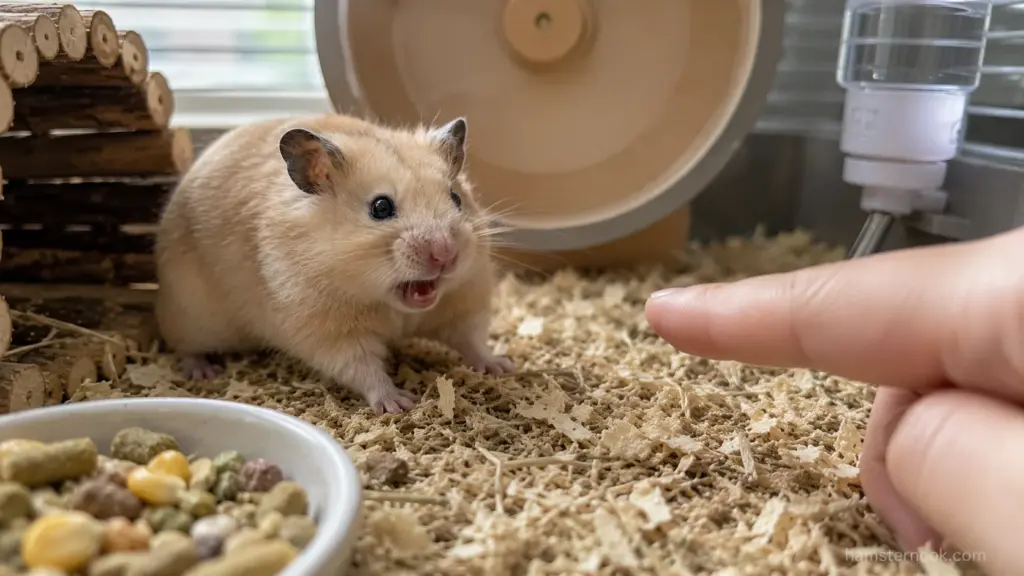
If your hamster shows defensive behaviors:
- Stay calm.
- Avoid sudden movements.
- Never punish the hamster.
- Allow it to retreat if it chooses.
- Continue offering food calmly.
- Build trust gradually.
- Respect sleeping hours.
- Keep handling sessions short.
Responding patiently almost always produces better results than trying to force immediate interaction.
Many defensive behaviors improve naturally once the hamster learns that you are not a threat.
If you’re currently working on taming, How Long Does It Take for a Hamster to Trust You? explains what to expect during the trust-building process and why patience is essential.
Unusual Hamster Behaviors Explained
Not every hamster behavior fits neatly into the categories of “normal” or “abnormal.” Some actions seem strange at first but are simply natural instincts expressed in unusual ways. Others may suggest that your hamster’s environment needs small improvements.
The key is to look at the context rather than the behavior alone.
Why Does My Hamster Sleep Outside Its House?
Many owners become concerned when they find their hamster sleeping in the open instead of inside its hideout.
In many cases, this is completely harmless.
A hamster may choose a different sleeping location because:
- The nest has become too warm.
- It has created a new sleeping chamber underground.
- It feels secure enough to rest elsewhere.
- The bedding arrangement has changed.
However, if your hamster suddenly abandons its nest while also appearing weak, cold, or unwilling to move, the behavior should be taken more seriously.
If you’ve noticed this change, Why Is My Hamster Sleeping Outside Its House? explains when it’s normal and when it may indicate a problem.
Why Does My Hamster Dig in Cage Corners?
Corner digging is one of the most frequently misunderstood behaviors.
Many owners assume the hamster is trying to escape.
Sometimes that’s true—but not always.
A hamster may dig in cage corners because:
- It wants deeper bedding.
- It is trying to extend a tunnel.
- It naturally prefers digging near solid surfaces.
- It is exploring the enclosure.
Persistent corner digging combined with bar climbing or repeated escape attempts may suggest the enclosure could benefit from more space or additional enrichment.
Why Does My Hamster Keep Climbing the Cage?
Climbing isn’t a natural behavior in most hamster species, but many pet hamsters will climb cage bars or other structures.
Occasional climbing isn’t usually a concern.
However, frequent climbing may indicate that the hamster is:
- Looking for new areas to explore.
- Seeking additional enrichment.
- Trying to reach a higher platform.
- Investigating its surroundings.
Because falls can cause injuries, owners should ensure that climbing opportunities inside the enclosure are safe and that dangerous heights are avoided.
Why Does My Hamster Try to Escape?
Every hamster occasionally investigates possible exits.
This doesn’t necessarily mean the hamster dislikes its home.
Wild hamsters naturally travel and explore large areas.
Domestic hamsters retain that curiosity.
Escape attempts may increase after:
- Cage cleaning.
- Rearranging the enclosure.
- Introducing new toys.
- Changes in routine.
Providing a spacious enclosure, deep bedding, hiding places, and enrichment usually helps satisfy this natural curiosity.
If this happens frequently, Do Hamsters Need a Bigger Cage? Signs Yours Is Too Small explains one of the most common reasons hamsters try to escape and what you can do to fix it.
Why Does My Hamster Rearrange Everything Overnight?
Owners often spend time creating a beautiful enclosure only to wake up and discover that tunnels, bedding, food bowls, and nesting material have all been moved.
This behavior is completely expected.
Hamsters naturally customize their environment by:
- Relocating bedding.
- Blocking tunnel entrances.
- Expanding nests.
- Creating new food storage areas.
- Adjusting tunnel layouts.
Rather than correcting these changes every morning, allow your hamster to organize its enclosure in a way that feels safe.
Why Does My Hamster Carry Food in Its Cheeks?
Hamsters have expandable cheek pouches that temporarily store food while they transport it.
These pouches are not used for digestion.
Instead, they allow hamsters to:
- Gather food efficiently.
- Carry nesting material.
- Transport treats.
- Move food into underground storage.
Owners should avoid squeezing or attempting to empty the cheek pouches, as doing so can cause injury.
Why Does My Hamster Suddenly Stop Using Its Wheel?
A hamster skipping its wheel for one night is usually not a reason to panic.
Activity levels naturally vary.
Possible explanations include:
- Increased exploration elsewhere.
- Environmental changes.
- Aging.
- Seasonal differences.
- Temporary changes in routine.
However, if wheel avoidance occurs alongside poor appetite, weakness, or difficulty moving, the behavior deserves closer observation.
Why Does My Hamster Keep Staring at Me?
Many owners feel as though their hamster is watching them.
In reality, the hamster is gathering information.
It may be:
- Listening.
- Smelling the air.
- Recognizing movement.
- Waiting for food.
- Deciding whether it is safe to approach.
Because hamsters rely heavily on hearing and smell, what appears to be “staring” is usually careful observation rather than emotional expression.
If you’re curious about this behavior, Why Does My Hamster Keep Staring at Me? explores several possible explanations.
Why Does My Hamster Suddenly Become More Active?
Occasionally owners notice a sudden burst of energy.
A hamster may spend an entire evening:
- Running.
- Digging.
- Climbing.
- Exploring.
- Rearranging bedding.
Provided the hamster continues eating, drinking, and behaving normally, occasional highly active nights are generally part of natural behavior rather than a cause for concern.
Why Observation Matters More Than Assumptions
One unusual behavior rarely tells the whole story.
Instead of asking,
“Why did my hamster do this once?”
Ask,
“Has my hamster’s normal routine changed over several days?”
Looking for patterns helps prevent unnecessary worry while also making it easier to recognize genuine problems early.
Many experienced hamster owners keep mental notes of their pet’s usual habits rather than reacting to every small change they observe.
How Hamster Behavior Changes Throughout Life

One of the biggest mistakes hamster owners make is expecting the same behavior throughout their pet’s entire life.
Just like people, hamsters change as they grow older. Their activity level, confidence, sleeping habits, curiosity, and interactions with their environment naturally evolve over time.
Understanding these age-related changes helps owners avoid confusing normal aging with illness or behavioral problems.
Baby Hamsters (Up to Around 8 Weeks)
Young hamsters are naturally energetic and curious.
During this stage, they spend much of their waking time learning about their surroundings.
Common behaviors include:
- Constant exploration.
- Frequent digging.
- Climbing anything they can reach.
- Playing with bedding.
- Running in short bursts.
- Investigating every new object.
Young hamsters are also more easily startled because they have little experience with people or household environments.
Gentle, consistent interaction helps build confidence without overwhelming them.
Young Adult Hamsters
Once settled into their new home, most healthy adult hamsters develop a predictable daily routine.
They often become:
- More confident.
- Better at building nests.
- More organized with food storage.
- Comfortable following regular feeding times.
Many owners also notice that their hamster begins recognizing familiar household sounds, such as the person who usually brings food or opens the enclosure each evening.
If you’ve been patiently working on taming, Do Hamsters Recognize Their Owners? 6 Signs Your Pet Knows You explains the subtle ways trust often develops over time.
Senior Hamsters
As hamsters grow older, their behavior usually becomes calmer.
You may notice gradual changes such as:
- Shorter periods of wheel running.
- More frequent resting.
- Slower movement.
- Longer grooming sessions.
- Less interest in climbing.
- More time spent inside familiar nesting areas.
These gradual changes are often part of the normal aging process.
However, sudden behavioral changes should never be dismissed simply because a hamster is older.
If an older hamster suddenly stops eating, drinking, moving normally, or interacting with its environment, veterinary advice should be sought promptly.
Seasonal Changes in Behavior
Although pet hamsters live indoors, seasonal changes can still influence their daily routine.
For example:
During warmer months
Some hamsters may:
- Sleep outside the nest more often.
- Drink slightly more water.
- Spend less time inside enclosed hideouts.
- Become active later in the evening.
During cooler months
You may notice:
- Longer periods spent inside the nest.
- Slightly reduced activity.
- More time arranging bedding.
- Increased nesting behavior.
These small seasonal differences are generally normal as long as room temperature remains safe and stable.
How Routine Builds Confidence
Hamsters thrive on predictability.
A consistent daily routine allows them to learn when food arrives, when the room is quiet, and when it’s safe to explore.
Try to keep these routines as consistent as possible:
- Feeding at roughly the same time each day.
- Spot cleaning instead of frequent full cage clean-outs.
- Gentle handling during normal waking hours.
- Maintaining a regular lighting schedule.
- Avoiding unnecessary disturbances during daytime sleep.
A predictable environment helps reduce stress and encourages natural behaviors.
Behaviors Owners Should Never Punish
Because hamsters act almost entirely on instinct, punishment has no place in hamster care.
Behaviors that should never be punished include:
- Biting out of fear.
- Hiding.
- Hoarding food.
- Digging.
- Rearranging bedding.
- Running away.
- Freezing.
- Sleeping during the day.
Instead of asking, “How do I stop this behavior?”, ask, “Why is my hamster behaving this way?”
Understanding the reason almost always leads to a better solution than trying to stop the behavior itself.
Common Mistakes That Accidentally Change Behavior
Sometimes behavioral problems develop because of everyday care mistakes rather than the hamster itself.
Examples include:
- Waking the hamster repeatedly during the day.
- Cleaning the entire enclosure too often.
- Removing all nesting material.
- Frequently changing cage layouts.
- Providing very little bedding.
- Handling the hamster before it has settled into its new home.
- Expecting immediate trust.
Correcting these habits often leads to noticeable improvements within a short time.
If you’re setting up your hamster’s habitat for the first time, Hamster Care Checklist can help you make sure you’ve covered all the essentials for a safe and comfortable home.
A Simple Daily Behavior Checklist
Spending just a few minutes observing your hamster each evening can help you notice small changes before they become bigger problems.
Ask yourself:
- Did my hamster wake up at its usual time?
- Is it eating normally?
- Did it drink water?
- Is it exploring the enclosure?
- Is the wheel being used?
- Has it groomed itself?
- Is it moving comfortably?
- Does the coat look clean?
- Has it built or maintained its nest?
- Does its behavior seem normal compared with yesterday?
No hamster will behave exactly the same every day.
The goal isn’t to look for perfection—it is to recognize meaningful changes from your hamster’s usual routine.
Understanding the Bigger Picture
The most experienced hamster owners rarely judge behavior based on a single action.
Instead, they observe:
- Daily routines.
- Appetite.
- Activity levels.
- Grooming habits.
- Sleeping patterns.
- Body condition.
- Interaction with the environment.
Looking at all of these together provides a much more accurate picture of your hamster’s wellbeing than focusing on one unusual moment.
As you become familiar with your hamster’s personality, you’ll find it much easier to recognize the difference between normal variation and genuine behavioral changes that deserve attention.
Key Takeaways Every Hamster Owner Should Remember
Understanding hamster behavior isn’t about memorizing dozens of individual actions—it’s about recognizing patterns.
Healthy hamsters spend most of their lives following natural instincts that have helped their species survive for thousands of years. Digging tunnels, storing food, sleeping during the day, running at night, grooming, and exploring their surroundings are all normal parts of being a hamster.
Instead of asking whether a single behavior is “good” or “bad,” ask whether it represents a change from your hamster’s normal routine.
For example:
- A hamster that always hides during the day is behaving normally.
- A hamster that suddenly refuses to leave its nest at night deserves closer observation.
- A hamster that regularly stores food is following a healthy instinct.
- A hamster that suddenly stops eating while also becoming inactive needs attention.
Looking for patterns rather than isolated behaviors helps owners make better decisions and avoid unnecessary worry.
Build Trust by Understanding, Not Controlling
One of the biggest lessons experienced hamster owners learn is that trust cannot be rushed.
Hamsters don’t become confident because they are handled frequently.
They become confident because they learn that their environment is safe and predictable.
Simple habits make a significant difference:
- Respect their sleeping schedule.
- Speak calmly around the enclosure.
- Allow them to approach voluntarily.
- Avoid sudden movements.
- Keep daily routines consistent.
- Provide enough bedding for natural burrowing.
- Offer enrichment that encourages exploration.
Over time, these consistent experiences help many hamsters become noticeably more relaxed and confident.
If your hamster is still adjusting to its new home, Why Your New Hamster Seems Scared of Everything (And How to Help) explains how confidence develops naturally over time.
Observe Before You React
Every hamster has quiet days and active days.
Some evenings they may spend hours on the wheel.
Other nights they may focus almost entirely on digging or rearranging their nest.
Both situations can be completely normal.
The most reliable approach is to observe first and react second.
Before assuming something is wrong, consider:
- Has anything changed in the environment?
- Has the enclosure recently been cleaned?
- Has the hamster’s diet changed?
- Is the room unusually warm or cold?
- Is the hamster eating and drinking normally?
- Has this behavior continued for several days?
Careful observation often provides the answer before any intervention becomes necessary.
Understanding Your Hamster Takes Time
Every hamster develops its own routine, preferences, and personality. Two healthy hamsters living in nearly identical environments may still behave very differently. One may spend hours digging while another prefers exploring or wheel running. Instead of comparing your pet with videos online or with someone else’s hamster, use your hamster’s own routine as the baseline. Over time you’ll notice subtle changes much earlier, making it easier to respond appropriately whenever something genuinely changes.
Final Thoughts
Hamster behavior is far more complex than many people realize.
Although these small animals rarely communicate in obvious ways, they constantly express themselves through movement, body language, scent marking, routines, and instinctive behaviors. Learning to understand these signals transforms everyday care from guesswork into informed observation.
Rather than trying to change natural behaviors, focus on creating an environment where those behaviors can be expressed safely. A spacious enclosure, deep bedding, appropriate enrichment, a balanced diet, and a predictable daily routine allow most hamsters to display the behaviors they have evolved to perform.
Most importantly, remember that no guide can replace learning your own hamster’s unique personality. The more familiar you become with its normal habits, the easier it will be to recognize genuine changes that deserve attention.
A hamster that feels safe is usually a hamster that behaves naturally—and understanding those natural behaviors is one of the best ways to provide excellent lifelong care.
Frequently Asked Questions
Is it normal for my hamster to sleep all day?
Yes. Most pet hamsters are naturally most active around dusk, throughout the night, and during the early morning hours. Sleeping for much of the daytime is normal and should not be mistaken for laziness or illness unless it is accompanied by other concerning symptoms.
Why does my hamster keep hiding food?
Food hoarding is one of a hamster’s strongest natural survival instincts. Even pet hamsters with unlimited food supplies continue storing food because their wild ancestors depended on food caches during times when food was scarce.
Why does my hamster suddenly hide more than usual?
Temporary increases in hiding can occur after cage cleaning, moving to a new home, or other environmental changes. If prolonged hiding is accompanied by reduced appetite, weight loss, or decreased nighttime activity, closer observation is recommended.
Why does my hamster run on its wheel for so long?
Wheel running allows hamsters to satisfy their natural instinct to travel and explore. Long periods of wheel running are usually normal provided the hamster remains healthy and shows no signs of injury or exhaustion.
Does my hamster recognize me?
Many hamsters gradually learn to recognize familiar voices, daily routines, scents, and predictable interactions. While every hamster has a different personality, many become noticeably more confident around people they interact with regularly.
Why does my hamster suddenly freeze?
Brief freezing is a natural defensive response that allows a hamster to assess unfamiliar sounds, movement, or scents before deciding whether it is safe to continue exploring.
Is rearranging the cage a bad sign?
No. Moving bedding, changing tunnels, relocating food stores, and rebuilding nests are all normal behaviors that allow hamsters to customize their environment.
Why does my hamster bite even though I treat it well?
Most bites are defensive rather than aggressive. Fear, surprise, pain, protecting the nest, or mistaking fingers for food are much more common explanations than aggression.
How can I tell if my hamster is stressed?
Stress may appear as increased hiding, reduced exploration, refusing treats, repeated escape attempts, or sudden changes in normal behavior. Looking for several changes together provides a clearer picture than focusing on one behavior alone.
When should unusual behavior become a concern?
Behavior deserves closer attention when several changes occur together, especially if they include loss of appetite, reduced water intake, difficulty moving, breathing changes, significant weight loss, or continued inactivity during your hamster’s normal active hours.
References
- PDSA – Hamsters: Looking After Your Pet
- Blue Cross – Hamster Care Advice
- RSPCA – Hamsters: Pets in the Home
- Merck Veterinary Manual – Small Mammals

Narayan Kumar is the founder and author of HamsterNook. He creates practical, research-based hamster care guides covering hamster behavior, nutrition, cage setup, enrichment, health, and everyday care. His goal is to help hamster owners make informed decisions and provide safer, healthier lives for their pets through clear, beginner-friendly information based on trusted animal care resources.